Projects
Topic 1: Ensemble reanalysis/reforecast of extreme weather events
南出 将志/Minamide Masashi
Project Associate Professor, Department of Civil Engineering, Graduate School of Engineering, The University of Tokyo
Interview
Q1 What do you study?
Figure: Simulation in which "small-scale" convective clouds are prevented from forming in a narrow region near the center of a tropical cyclone.
I study extreme weather phenomena—such as tropical cyclones and linear mesoscale convective systems—focusing on their mechanisms and predictability.
My central research involves improving prediction accuracy via data assimilation. This technique combines two information sources of different quality to estimate current states. A typical meteorological application is combining numerical model outputs with atmospheric observations (e.g., temperature, humidity) to estimate the Earth's atmospheric state.
In particular, I frequently use satellites that observe clouds from space to capture the evolving inner-core structure of tropical cyclones, in order to better reproduce and predict the wind and precipitation that impact society.
In particular, I frequently use satellites that observe clouds from space to capture the evolving inner-core structure of tropical cyclones, in order to better reproduce and predict the wind and precipitation that impact society.
Q2. Could you tell us about your role in the Moonshot project?
We aim to discover potential triggers that inhibit the development of convective clouds and subsequent tropical cyclones.
Meteorological phenomena exhibit the butterfly effect—a tiny perturbation, like a butterfly’s wing flap, can trigger extreme events like single thunderstorms, tornadoes, or tropical cyclones.
In the Moonshot project, we aim to harness that chaotic sensitivity: using a relatively small energy input to suppress or control the enormous energy of a tropical cyclones. That means investigating where to intervene and what change to induce to effectively alter extreme weather phenomena.
We’re also working to create a high-precision dataset by applying our satellite data-assimilation system to historical tropical cyclones, reproducing their internal structures and convective cloud development at unprecedented fidelity.
In the Moonshot project, we aim to harness that chaotic sensitivity: using a relatively small energy input to suppress or control the enormous energy of a tropical cyclones. That means investigating where to intervene and what change to induce to effectively alter extreme weather phenomena.
We’re also working to create a high-precision dataset by applying our satellite data-assimilation system to historical tropical cyclones, reproducing their internal structures and convective cloud development at unprecedented fidelity.
Q3. What current challenges do you face?
To achieve the “control of convective clouds and tropical cyclones,” sufficient intervention must be carried out during the window between when their formation becomes predictable and when they actually develop.
For instance, if we needed to reduce water vapor by 20% in a region inside a tropical cyclones, but we can only reduce it at 10% per hour, then we'd need to start two hours prior to occurrence—meaning we require sufficient lead time.
Thus, securing enough lead time is critical to control feasibility. However, our understanding of tropical cyclone predictability—especially the lead time necessary for effective intervention—is still insufficient.
Current knowledge still does not provide sufficient lead time to effectively influence the development of tropical cyclones. Advancing our understanding in these fundamental areas of research through the Moonshot project will be key to overcoming this barrier and achieving meaningful breakthroughs.
Thus, securing enough lead time is critical to control feasibility. However, our understanding of tropical cyclone predictability—especially the lead time necessary for effective intervention—is still insufficient.
Current knowledge still does not provide sufficient lead time to effectively influence the development of tropical cyclones. Advancing our understanding in these fundamental areas of research through the Moonshot project will be key to overcoming this barrier and achieving meaningful breakthroughs.
Q4 How does this basic science of typhoon control enhance our understanding of tropical cyclones?
Studying atmospheric dynamics from an entirely new approach—tropical cyclone and weather control—not only yields control methods, but also enriches our scientific understanding of meteorological phenomena.
Although it might seem that control research develops only technologies and theories for control, in reality, these insights extend far beyond. Weather control and weather forecasting solve the same mathematical problems; thus, theoretical advances in control are likely to simultaneously improve forecast accuracy.For example, in this weather control study, we are advancing our research by artificially creating scenarios in simulations that would not naturally occur—such as investigating whether a tropical cyclone could still exist if, during its development, clouds failed to form in a specific location.
Through this kind of approach, we are gaining new insights into the mechanisms of tropical cyclones — for example, uncovering that certain conditions previously overlooked may in fact have a significant impact on tropical cyclone formation.
These insights are essential not only for considering the potential to control tropical cyclones but also for improving prediction accuracy. Furthermore, in this weather control project, I am collaborating with researchers from fields I have not previously been directly involved in, such as machine learning and social sciences, in addition to meteorology.
By studying atmospheric dynamics from these new and different approaches, we are making significant progress not only in the potential for control but also in our overall understanding of weather phenomena.
Figure: Schematic illustration of modifying a powerful tropical cyclone through small energy interventions

Q5 How does this project differ from previous weather-control research?
One of the most significant differences in our approach is that we ask whether it is possible to effectively influence weather phenomena through small-scale energy interventions.
Traditionally, weather control has often been imagined as a direct, localized action— such as seeding clouds to make it rain in a specific area.
In contrast, our Moonshot project targets extremely large-scale phenomena like tropical cyclones , which possess enormous amounts of energy. Attempting to directly eliminate such systems is simply not realistic.
However, the atmosphere exhibits chaotic behavior known as the butterfly effect, where a seemingly minor disturbance can lead to significant downstream impacts.
If we can identify such subtle but critical phenomena—ones that may appear insignificant at first but play a key role in the development of extreme weather—we may be able to exert effective control over a tropical cyclone using far less energy than the system itself contains.
The excitement of this project lies in tackling that very challenge: how can we discover those hidden leverage points within the chaotic dynamics of the atmosphere?
Figure: Example of water vapor field signals that play a crucial role in convective cloud formation (from Minamide and Posselt, 2022)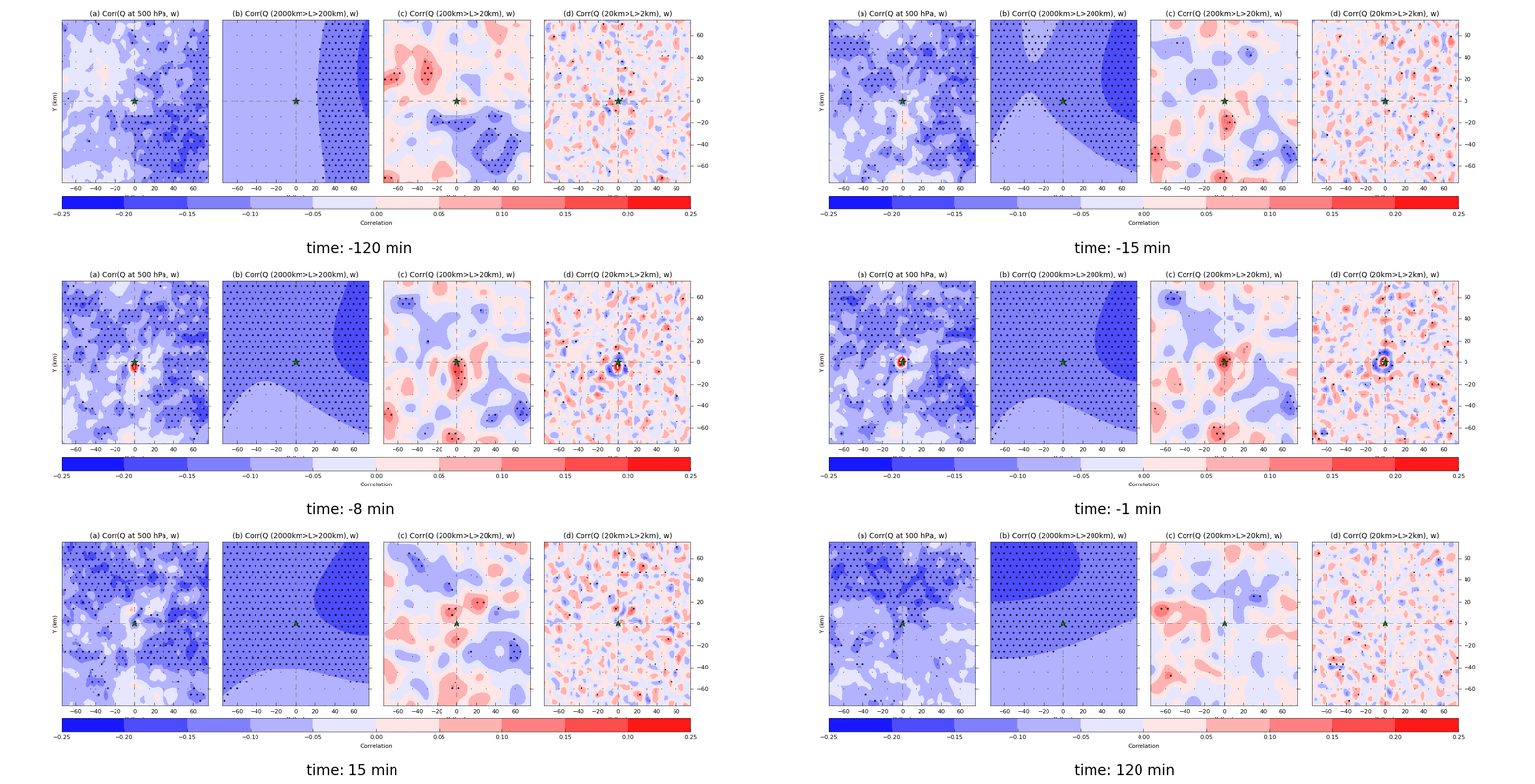
In contrast, our Moonshot project targets extremely large-scale phenomena like tropical cyclones , which possess enormous amounts of energy. Attempting to directly eliminate such systems is simply not realistic.
However, the atmosphere exhibits chaotic behavior known as the butterfly effect, where a seemingly minor disturbance can lead to significant downstream impacts.
If we can identify such subtle but critical phenomena—ones that may appear insignificant at first but play a key role in the development of extreme weather—we may be able to exert effective control over a tropical cyclone using far less energy than the system itself contains.
The excitement of this project lies in tackling that very challenge: how can we discover those hidden leverage points within the chaotic dynamics of the atmosphere?
Figure: Example of water vapor field signals that play a crucial role in convective cloud formation (from Minamide and Posselt, 2022)
Q6 If weather control were to become a reality by 2050, what kind of society would you like to see?
We hope that by 2050, the damage caused by water-related disasters can be dramatically reduced.
This weather control project aims not only to mitigate the impact of disasters by actively modifying severe weather phenomena, but also to significantly improve the accuracy of weather forecasting. With both of these elements in place, we believe there is great potential to substantially reduce the damage from floods and other water-related hazards by mid-century.When I was a student, I participated in numerous disaster relief efforts both in Japan and abroad, following major events such as the Great East Japan Earthquake and typhoons in the Philippines. Through those experiences, I witnessed firsthand the devastating impact of tsunamis and typhoons, and came to realize that even in today’s world—where infrastructure is highly advanced—flood-related disasters can still cause enormous societal damage.
In interviews with disaster survivors, I often heard stories like: “The river was rising more than usual, so I evacuated just in case—and that saved my life.” This made me feel that if people could receive accurate forecasts and alerts earlier, they might be able to avoid harm more effectively.
Through the Moonshot Goal 8, we aim to reduce the negative consequences of extreme weather through a two-pronged approach: first, by detecting tropical cyclones and other severe weather events at an earlier stage, and second, by transforming them into less damaging phenomena through intervention. I hope that by pursuing these approaches, we can create a society free from the fear of water-related disasters.
